A new piece republished by Phys argues that 2026 may be remembered as the year mathematics had an identity crisis. Frontier AI models from OpenAI and Anthropic, per the article, made stunning progress on major open problems. If you use AI tools for homework, work, or curiosity, the debate offers a useful lesson: getting a correct answer and understanding it are two different things. Here is how to tell them apart in your own use of AI.
What the Phys article reports
The article argues that frontier AI systems have rapidly solved, or claimed progress on, big open math problems. It says AI agents, formal verification, and massive computing power could shift mathematics from human-led theory-building toward industrial-scale production of results.
It also describes alleged breakthroughs on problems like Navier-Stokes and the Riemann hypothesis, which provoked backlash from leading mathematicians. Note the word "alleged": the article frames these as claims that are contested, and this piece does not independently confirm any of them.
Why a correct answer isn't the whole point
The core tension is simple. Mathematicians, the article suggests, care about understanding, not just answers. A proof that a statement is true is one thing. Knowing why it is true, and what that reveals about other problems, is another.
Think of it like a calculator that gives you the right figure for your tax return. You have the number, but you haven't learned how taxes work. A tool can finish the homework without the lesson being learned.
Three ideas are worth keeping separate:
- Proof: a logical argument that a claim is true.
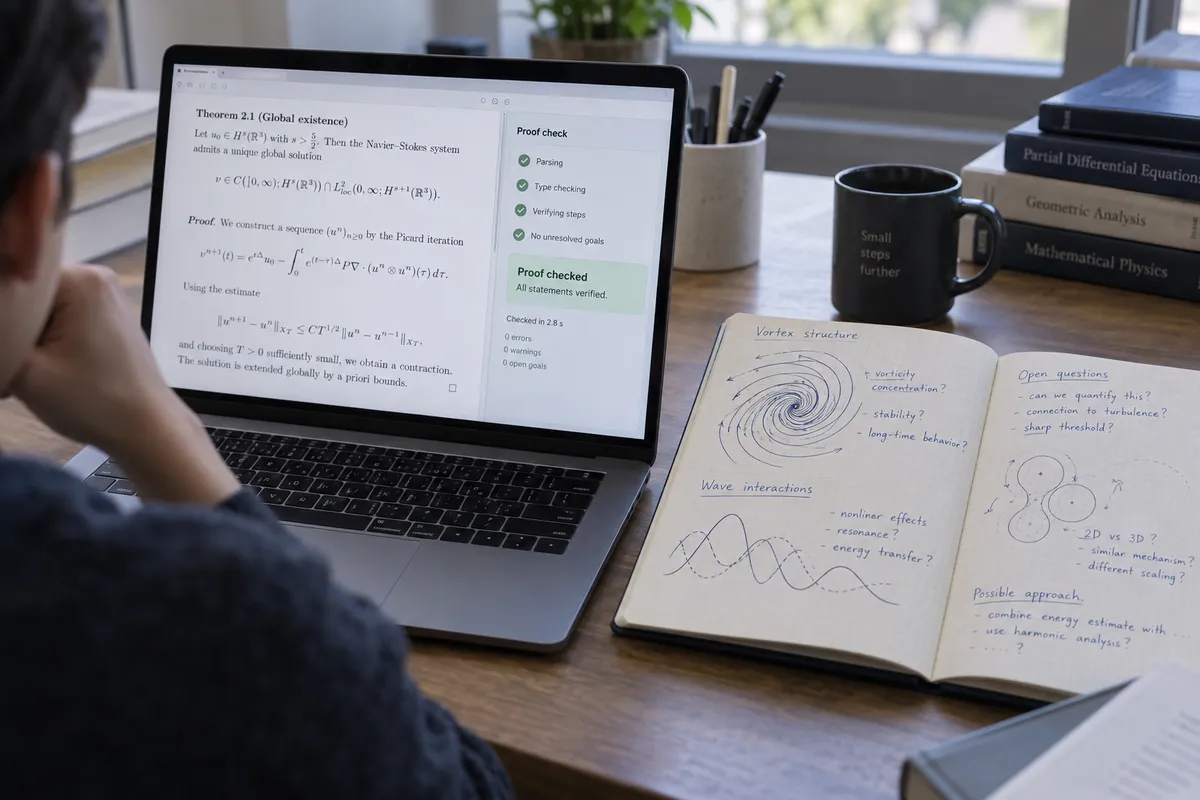
- Verification: a check that the argument has no errors. The article points to formal verification, where software checks each step.
- Understanding: the human grasp of why the result holds and how it connects to other ideas.
AI can plausibly speed up the first two. The worry is that the third gets left behind.
Research as an assembly line
The article raises a bigger concern than any single result. If AI agents with huge compute can churn out results at scale, mathematics could start to look like industrial output rather than a craft built around slowly developing theories. Incentives, training pathways, and the culture of the field could all change, the piece says.
That includes the question of what happens to Ph.D. students if AI is doing the breakthroughs. Traditionally, students learn by struggling with hard problems. If the hardest problems are handled by machines, the training path becomes unclear. The article presents this as a risk to the field, not a settled outcome.
What this means for your own AI use
You don't need to be a mathematician to apply the lesson. Whenever an AI gives you an answer, try these habits.
1. Ask it to explain the reasoning
After you get a result, ask the tool to walk through why it works in plain language. If you can't follow the explanation, treat the answer as unconfirmed.
2. Verify independently
Mathematicians are turning to formal verification, which is a mechanical check. You can do a lighter version: test the answer against a second source, a spreadsheet, or a worked example you do yourself.
3. Do the first attempt yourself
If you're learning something, try the problem first, then use AI to compare. Skipping the struggle is the part the article warns could erode expertise.
4. Treat big claims cautiously
The backlash from leading mathematicians shows that dramatic announcements get scrutinized. When you see a headline about AI solving something famous, look for whether experts have confirmed it.
The takeaway
The mathematics debate is really about a question every AI user faces: are you collecting answers or building understanding? Next time an AI hands you a result, make it earn your trust by explaining itself, then check it before you rely on it.